Find, strike, protect: MCL at MIDRT and DVD 2026
13 October 2026
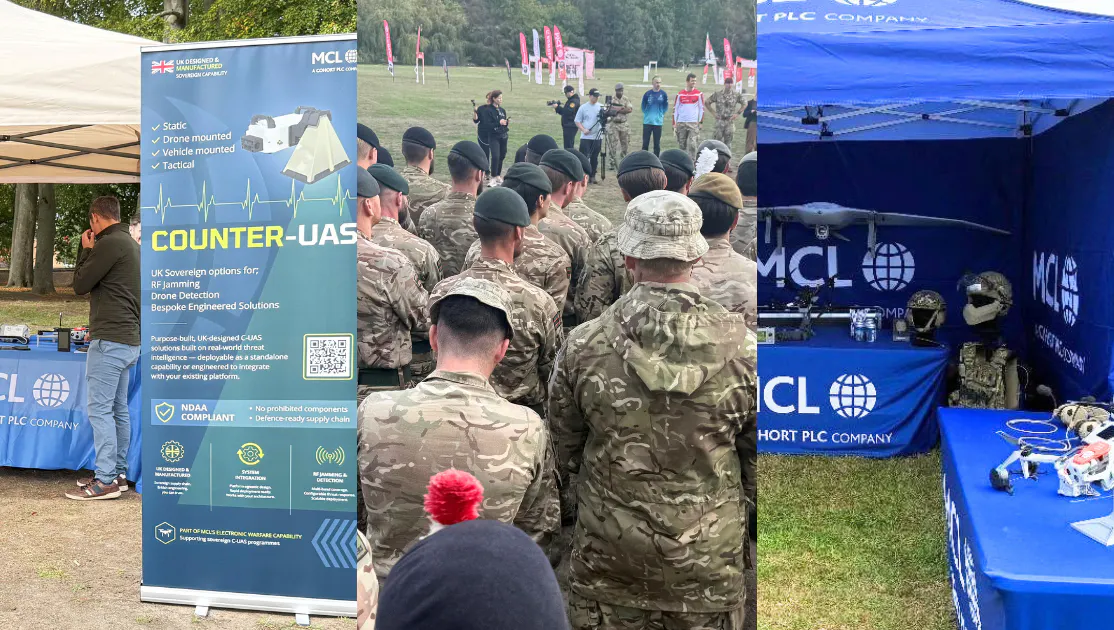
Earlier last month, MCL joined British Army drone operators at Sandhurst and the Army’s RAPSTONE stand at Millbrook, demonstrating how ISR, FPV strike, interception and detection capability helps them find, strike and protect, faster.
Cheap, plentiful drones are reshaping the land battle. Lessons from Ukraine show that troops can now be spotted from above and struck within seconds, and that hiding on the modern battlefield is harder than ever.
The British Army is adapting fast. In September, soldiers gathered at the Royal Military Academy Sandhurst (RMAS) to test how they find and strike targets with drones, in training recently covered by The Times. MCL were there as sponsor of the British Army Drone Sports Association (BADSA), and the same week joined the British Army’s Task Force RAPSTONE stand at Defence Vehicle Dynamics (DVD) 2026.
Speaking to The Times, Brigadier Ed Cartwright explained that the Army has traditionally prized lethality, protection and mobility in its equipment, but “now we’re talking about scale, speed and affordability of uncrewed systems.”
For industry, the challenge is delivering proven capability quickly, at a cost that allows soldiers to field it in numbers.
MIDRT at RMAS
The Military International Drone Racing Tournament (MIDRT) ran alongside the British Army Tactical Drone Competition (BATDC) at RMAS from 14 to 18 September. Racing tested pure pilot skill, while the BATDC set teams of four realistic patrol tasks combining ISR overwatch with FPV strike.
As BADSA sponsor, MCL were joined on their stand by two partners: DK NEJET, a Ukrainian-Latvian developer of battle-proven autonomous FPV strike and interceptor drones, and Menace RC, an FPV specialist known for high-performance antennas, frames and components, now increasingly designing and building in-house to support sovereign capability. The stand also showcased systems from Skydio and other MCL partners. Across three days of racing, demonstrations and a VIP visit by senior Army commanders, the team spoke with pilots, unit drone leads and brigade staff about the capability they need now.
MCL also brought their UK-designed and manufactured FPV flight controller and electronic speed controller (ESC).
The BATDC mirrored a reality that soldiers are already facing. Finding a target, striking it and protecting yourself from the same threat are now one continuous task, and the kit has to support all three.
Find, strike, protect, warn
MCL’s uncrewed systems portfolio covers each part of that task, and every element was in front of Army users at MIDRT.
Find: Skydio X10D
Many of the soldiers at MIDRT had recently received Skydio X10D sUAS through the £14M contract MCL secured with the MOD earlier this year. MCL delivered 400 units within eight weeks of order, and 820 have now been delivered to date. The X10D gives dismounted sections their own short-range ISR and reconnaissance, and is ready to fly in under 40 seconds. Onboard AI and 360-degree obstacle avoidance let it fly autonomously, including at night and in GPS-denied or high-EMI environments, so operators can focus on the mission rather than the controls. It carries high-resolution telephoto, wide and narrow cameras alongside a FLIR Boson+ thermal imager, with up to 40 minutes’ flight time and a range of up to 12 km. Feedback from units now flying the X10D was strongly positive, and the MCL team captured user insight to support training and in-service use.
Strike: DK NEJET FPV
Army pilots flew DK NEJET’s Pastnieks 10-inch strike drone during the event. It is a high-capacity FPV platform designed to defeat armoured vehicles and fortified positions, carrying a payload of up to 3.6 kg at speeds of up to 110 km/h over a range of 25 km. Optional thermal optics allow it to operate by day or night. Developed with frontline units in Ukraine and NATO-codified, it impressed pilots with its handling, its likely price and its short lead times.
Protect: DK NEJET interceptor
DK NEJET’s NS3 interceptor is a high-speed counter-UAS platform built to catch and destroy fixed-wing attack and reconnaissance drones. With a cruise speed of 210 km/h, terminal speeds of up to 350 km/h and a range of 20 km, it offers a low-cost layer of protection against the cheap aerial threats soldiers now face daily.
Warn: Meerkat
Meerkat is MCL’s own UAS detect and monitoring capability, a self-funded development taken from concept to working prototype in just three months. Operating passively across key drone transmission bands (1.2, 3.3 and 5.8 GHz), it intercepts a hostile drone’s video feed to show soldiers what the drone can see, while direction-finding its signal to show where it is coming from. Because Meerkat emits no RF signal of its own, it provides early warning without giving away the user’s position, buying vital time to respond. Interest at MIDRT was high, and soldiers’ feedback on use cases and design priorities is now feeding directly into its development.
DVD 2026 on the RAPSTONE stand
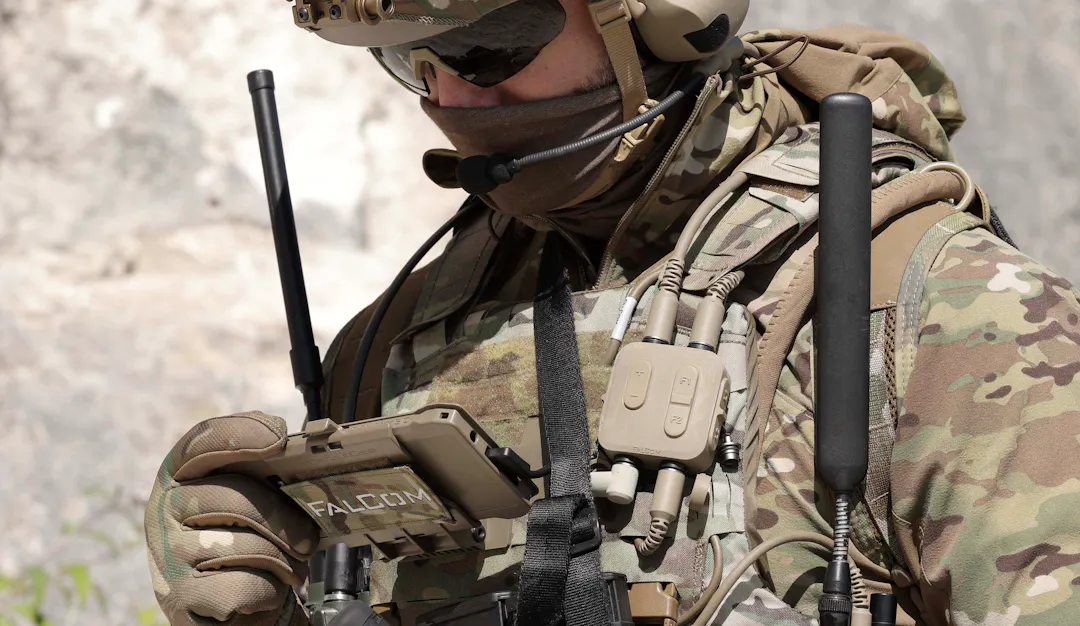
The same week, MCL were invited to join the British Army’s Task Force RAPSTONE stand at DVD 2026, held at UTAC Millbrook on 16 and 17 September. RAPSTONE is the Army’s initiative to accelerate new equipment into service using lessons from Ukraine, and the stand showcased capability fielded through the programme. Among the systems on display were two MCL have supplied through RAPSTONE: Skydio X10D sUAS and FalCom’s MFC1000 and MFC2000 communications control units and associated cabling. The FalCom units link soldiers’ headsets to their radios, with separate volume control for each channel, keeping them connected while protecting their hearing.
DVD 2026 ran under the theme “Connected for Combat”, focussed on aligning people, systems and decisions across the land force. Alongside the Army’s own displays, MCL showcased their tactical and uncrewed systems to MOD staff, delivery teams and land equipment users.
The conversations at Millbrook echoed those at Sandhurst, focussing on effective, affordable systems that units can field quickly, and on how industry can help close that gap.
Supporting the Army
MCL’s sponsorship of BADSA reflects a simple belief: the best way to build capability for soldiers is to listen to them. Drone sport develops the speed, judgement and flying skill that operators need in the field, and it gives industry direct access to the people who use the equipment.
That feedback loop shaped MCL’s September. Skydio users shared their in-service experience, Army pilots put DK NEJET drones through their paces, and soldiers’ input on early warning is now helping to shape Meerkat’s development.
MCL have served the UK MOD since 1980, fielding the capability the UK needs, fast. They secure sovereignty for all their fielded kit, so that it is sourced, assured and sustained in Britain. As drone warfare reshapes the battlefield, they remain focussed on fielding proven capability quickly, so British soldiers can find, strike and protect against the threats they face.
To find out more about MCL’s capabilities or to arrange a demonstration of Meerkat, Skydio or DK NEJET systems, contact the MCL team today.